
From Crescendo to Silence...
by Furqan Ali

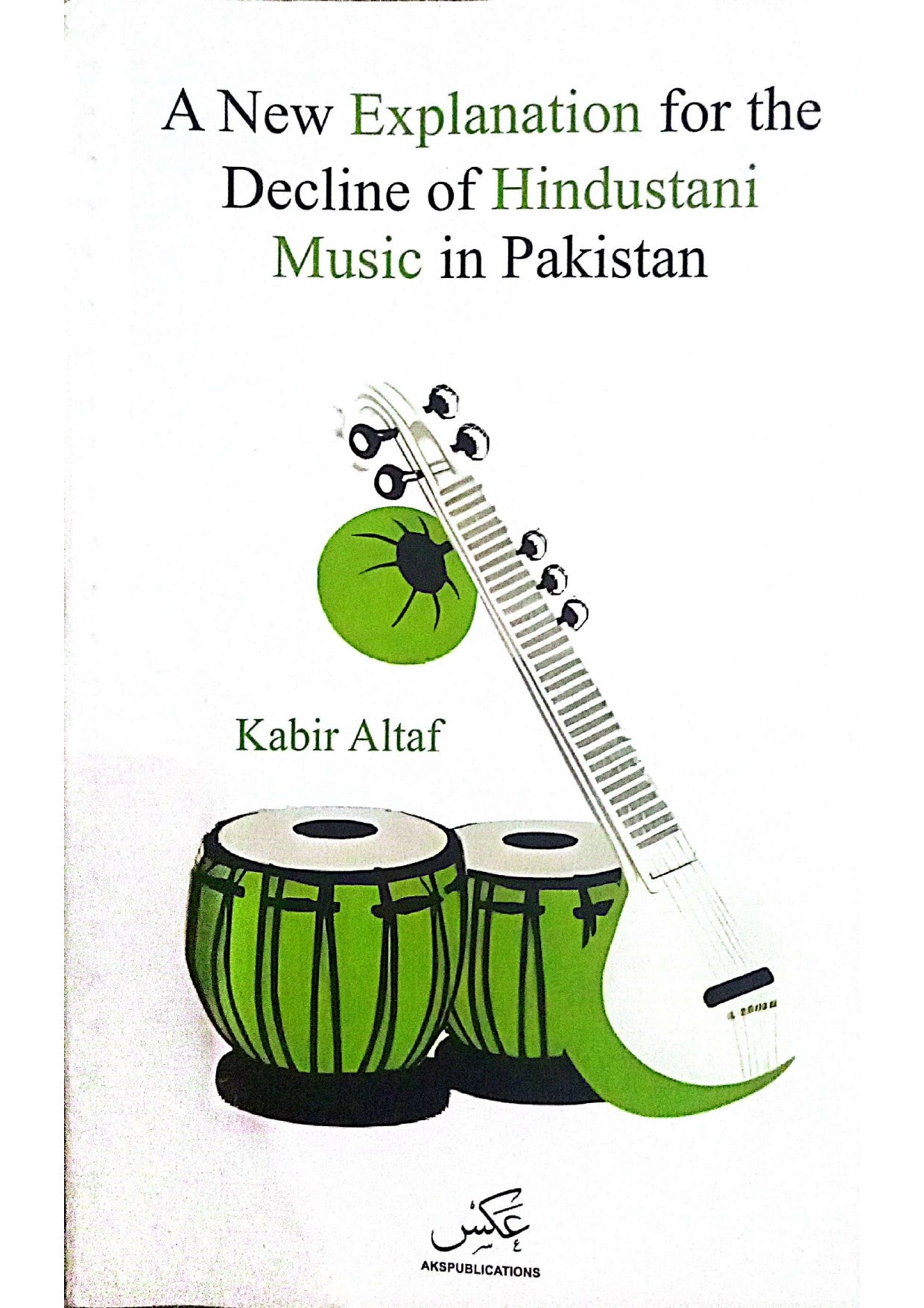
Name: A New Explanation for the Decline of Hindustani Music in Pakistan
Author: Kabir Altaf
Publication: AKS PUBLICATIONS
While ransacking barrages of inked pages for a book, I stumbled upon this gem: “A New Explanation for the Decline of Hindustani Music in Pakistan” by Kabir Altaf. As the title suggests, it delves into the vitriolic and gloomy turndown of a once-vibrant tradition. Kabir, himself a classical vocalist, offers firsthand testimony.
When I think of Hindustani music, a particular video conjures in my mind—Rustam Fateh Ali Khan and his father, Bade Fateh Ali Khan, humming Raag Bhopali. It is phenomenal, legendary, and subliminal. Please, listen here.
Both artists belong to the Patiala Gharana. As the book explains, a gharana is “a lineage of hereditary musicians, their disciplines, and the particular musical style they represent.” Each gharana has a distinct, coherent identity passed down to disciples and descendants.
The Patiala gharana, one of the most prominent, traces its roots to the 19th century and founders Ali Bakhsh Khan and Fateh Ali Khan—two friends trained by Mian Qutb Baksh (Tan Rus Khan), the court musician of Bahadur Shah Zafar. After Partition, they migrated to Lahore, leaving behind the Maharaja of Patiala’s court. Despite the dwindling environment (which is the book's main thesis, more on that soon), the gharana still resonates with an archaic hue.
The book establishes that Hindustani classical music, also known as Śāstrīya Sangeet, dates back to the Natya Shastra (200 BCE – 200 CE), bifurcated into Hindustani and Carnatic styles around the 12th century. As Kabir notes:
“Hindustani music is a combination of extant forms and imported elements entering India with the advent of Muslim rule starting around the 11th century AD.”
Ergo, Muslim contributions were foundational. Amir Khusrau is often credited with innovations such as the sitar, tabla, and genres like khayal and qawwali, which reflect Indo-Islamic cultural fusion.
Pakistan, at one point, was central to this musical journey. Consider the Rikhi Ram Musical Instrument Company, one of the world’s foremost sitar-makers, founded in 1920 in Lahore’s Anarkali. Today, due to declining quality and demand, only one sitar is produced per month in Pakistan.
The decline is also pedagogical. Gandharva Mahavidyalaya, the first-ever music university in the region, was established in Lahore by Pandit D. V. Paluskar in 1901. It produced many acclaimed musicians. Now, there is none.
The contrast with the past is stark. Even allowing for nostalgia, the gap is haunting and mind-boggling. Pakistan no longer produces vocalists like Ustad Amanat and Fateh Ali Khan, Roshan Ara Begum, or Ustad Nazakat and Salamat Ali Khan; nor instrumentalists like Ustad Bundu Khan, Shaukat Hussain Khan, or Sharif Khan Poonchwaley—not to mention the debilitating audience.
Three Common Explanations for the Decline:
1. The Contested Status of Music in Islam: Ghazali allowed music under certain contexts—its acceptability depends on time, place, and company. But clerics like Maududi associated music with sybaritic indulgence. As the state began promoting it (extreme religiosity) for political reasons, the public grew skeptical. Kabir cites:
“Ustad Jhande Khan would teach his daughter sitar, but periodically a sense of religious fervour would cause him to unstring the instrument and declare that such an activity would not go on anymore in his house.”
Shortcoming: Despite occasional religious opposition, Muslim rulers long patronized gharanas. Khayal compositions are often devotional and benign. Moreover, music isn’t categorically haram—context matters.
2. National Identity and Cultural Shifts: Post-independence, genres like dhrupad, dhamar, and thumri were labeled too “Hindu,” while khayal, tarana, qawwali, and ghazal were promoted for being “less Hindu.” References to Hindu deities were censored. As a result, qawwali became mainstream—it offered a musical experience that was spiritual, serious, and entertaining.
Shortcoming: Music thrived historically through Islamic-Hindu intermixing (e.g., Khusrau’s legacy). Furthermore, the Pakistani state never explicitly waged war on classical music—unlike, say, the Taliban. PTV supported classical music and even launched shows like Firdaus-e-Gosh (2013).
3. Loss of State Patronage: Ustad Bade Ghulam Ali Khan returned to India in 1957 due to lack of support in Pakistan—he was welcomed personally by Nehru. The state’s focus on Islamization further isolated classical traditions.
Shortcoming: Primarily, anti-Indian sentiment intensified after the 1965 war, branding Hindustani music “enemy’s music.” Yet even then, PTV supported artists like Amanat-Fateh Ali and Roshan Ara. The decline of quality began earlier, possibly in the 1960s. This patronage doesn’t explain fully why the quality declined even when patronage was there post partition and before the rapid Islamisation by Zia or neighbouring roils.
The New Explanation:
Kabir Altaf’s argument? It’s not just religion, national identity, or patronage that led to the decline. The real catalyst was Partition. With Partition came the migration of the Hindu and Sikh elite, patrons of high art. Their departure removed key cultural consumers and connoisseurs.
Hindustani music was long supported by elite circles—post-Partition, it was viewed as part of a sybaritic lifestyle (echoing Maududi). Without Maharajas or art-minded elites, patronage cycles collapsed. The ustad–shagird model also waned. Gharanas lost their institutional coherence. Modernization, westernization, and changing tastes did the rest.
Kabir concludes that it wasn’t an ideological shift in Pakistan’s identity but rather the migration patterns that reshaped the cultural terrain. Unlike India, Pakistan lost the ecosystem that sustained classical music.
Coda: Read it.
That’s all, folks.
Furqan Ali: The writer is the co-founder of the Policy Club, a Peshawar-based researcher, and also writes fiction and poetry sporadically.
Linkedin | Substack | Linktree
Thanks for the insightful review!