
The Audacious Faraz
By Furqan Ali

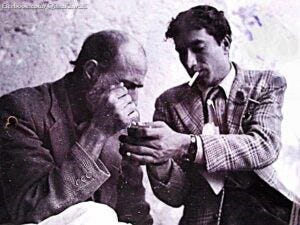
In the aftermath of the controversial (sic) 27th Amendment and the ensuing scathing, mournful, and damning resignation of Supreme Court judges Mansoor Ali Shah and Athar Minallah, a curious revival has taken place in Pakistan’s public discourse: Ahmad Faraz (1931-2008) has returned to the conversation. And I am so happy. Not only because Urdu poetics has re-entered the mainstream, but also for a personal reason: Faraz and I share the same alma mater, Edwardes College, Peshawar.
Every Tom, Dick, and Harry, it seems, is now quoting him, especially Shah’s chosen lines from Muhasara, Faraz’s magnum opus and one of the boldest poetic indictments of General Zia-ul-Haq’s authoritarian regime. It was this poem that led to Faraz’s arrest right after a mushaira, his words deemed too potent, his pen too dangerous.
“Mirā qalam to amānat hai mere logoñ kī / Mirā qalam to adālat mire zamīr kī hai,”
he wrote. My pen is a trust of my people, my pen is the court of my conscience. And with that declaration, he placed poetry not in the service of beauty alone but of truth, justice, and defiance. The poem continues, blending fire and grace:
Isi liye to jo likhā tapāk-e-jāñ se likhā / Jabhī to loch kamāñ kā zabān tiir kī hai.
(It is for this reason that what I wrote, I wrote with the fervor of my soul—thus my tongue, like the bow’s string, speaks with the arrow’s precision.)
That metaphor—the pen as both conscience and weapon—captures the audacity of Faraz. His poetry was not mere ornamentation of language; it was a living pulse of rebellion. Yet his work should not be reduced to merely political commentary. Faraz was often misrepresented by the sensationalist press, which confused his social persona with his poetic self.
Socially, he could be outspoken, iconoclastic, loud, even abrasive or confrontational, but this reflected his social posture, not the essence of his poetry. As Dr. Nomanul Haq observes:
“Faraz-the-poet was sublime, soft as silk, a lover who was always gentle; he was like a piece of live coal burning ever so slowly as the particles of ashes conspire to extinguish it. His metaphors were not of “prophecy” nor of “vision”; no, his metaphors were soaked in romance, longing and desire. He spoke of fireflies, butterflies, pearls; he invoked the moon and stars descending from the heavenly spheres to catch a glimpse of his beloved. If his words were ever harsh, that was an exception; and if he wrote “poetry of resistance and dismissal”, its volume is very thin.”
Faraz’s poetic consciousness was not a spontaneous spark but a cultivated flame. He inherited both an aesthetic and intellectual legacy: his father, Muhammad Shah Burk—himself well-versed in Persian as well as Urdu and Hindko—encouraged him to read widely and write thoughtfully. In Faraz’s poetry, not only are Persian words, compounds, and idioms skillfully used, but there is also a deep understanding of and engagement with the intellectual and technical traditions of Urdu and Persian literature. He pays homage to classical poets, including Naziri Nishapuri (1560 –1614), in Tanha Tanha, Rumi (1207-1273) in Nayaaft, and many other Indo-Persian poets. The following couplets exemplify this:
مسافت دل کی تھی سو جادۂ مشکل پسند آیا
ہمیں بھی مثلِ غالبؔ گفتۂ بیدلؔ پسند آیا
سمر قند و بخارا کیا ہیں خالِ یار کے آگے
سو ہم کو مصرعۂ حافظؔ بجان و دل پسند آیا
The journey was of the heart, so the difficult path appealed to me;
Even to us, a phrase of Bedil, like Ghalib’s, was pleasing.
What are Samarkand and Bukhara before the beauty mark of the beloved?
Thus, a couplet of Hafez pleased us with both mind and heart.
That Persian influence—balāghat (rhetorical grace) married to Urdu’s lyrical lehja—gave birth to a voice that fused intellectual precision with emotional delicacy. In Faraz’s poetry, one never feels the weight of scholarship despite its presence. His fluency is effortless, his modernity organic. He never abandons the classical tradition; rather, he extends it—stretching it until it holds within it new imagery, new psychology, and new protest.
His ghazals breathe the continuity of Persian romantic mysticism, yet their beloveds have evolved. They are no longer ethereal symbols of divine love but reflections of human experience—of exile, alienation, and longing. Love, for Faraz, is a universal force, not confined to the mystical or the metaphysical; rather, it is humane (thoroughly anthropomorphic, non-Platonic). At times, it is a psychological necessity, an existential mode of being.
تو خدا ہے نہ مرا عشق فرشتوں جیسا
دونوں انساں ہیں تو کیوں اتنے حجابوں میں ملیں
Neither are you God nor is / my love the angel’s sort
Both are human beings then why, in veils should we consort?
Further, he explicitly mentioned in an interview:
Naeem Bukhari: Are you, temperamentally, a romantic person?
Ahmad Faraz: Yes, absolutely. I believe in passionate, complete love — love for a whole person. I’m not a supporter of Platonic love, the kind that’s rooted in frustration. In that kind of love, you end up wasting half of your existence. That’s why you can’t give someone complete love unless you offer your entire being to them. So I desire complete love, as a complete person. Love for whom you cry, laugh, miss deeply — someone who becomes entirely embedded in your existence.
In this way, Faraz humanized love—turning it from divine ecstasy into lived struggle. Even in his humanity, he does not seek an idealized human, but one with all its flaws. Unlike the poets of hyperbolic romance, whose beloveds are steeped in spiritual abstraction, Faraz’s romanticism is modern, conflicted, and worldly. His concept of love is dynamic, wavering between ideal and reality, hope and despair, the personal and the political. This contradiction is not a flaw but a reflection of his philosophical understanding of life. And neither is his beloved a nonchalant, teenage figure; rather, she is a conscious human, unlike what Iqbal described in his stray reflections:
“A woman of superb beauty with a complete absence of self-consciousness is to me the most charming thing on God’s earth.”
Faraz, on the other hand—as Parveen Shakir explains—gauges the sensibilities of his beloved even in love, by quoting:
ہر حُسنِ سادہ نہ دل میں اُتر سکا
کُچھ تو مزاجِ یار میں گہرائیاں بھی ہوں
Simple beauty alone could not settle in the heart,
There must also be some depth in the beloved’s temperament.
Further, his individuality (infiradiyat) did not lie in inventing new forms but in reanimating old ones with contemporary urgency. He employed traditional rhetorical devices—semantic devices (sanā’e maʿnavī) and verbal devices (sanā’e lafẓī)—but with renewed intent. The beauty of his verse lay not in novelty but in relevance. An example of paronomasia:
لب تشنہ و نومید ہیں ہم اب کے برس بھی
اے ٹھہرے ہوئے ابر کرم اب کے برس بھی
Our lips are still parched and we stand despairing this year as well,
O motionless cloud of mercy, please rain down grace!
Consider his command of sound and sense. In Faraz, husn-e-saut (beauty of sound) and husn-e-ma‘ni (beauty of meaning) coexist harmoniously. In poetry, aesthetic effects arise from tarannum (melody) and naghma (musical resonance). Tarannum emerges from the pleasing flow of vowels and consonants; in Faraz, particularly in his ghazals, it is central. Likewise, naghma, created by the melodious interplay of sounds, suffuses his verbal and semantic devices. His words hum like music yet strike like verdicts, as evident from Mehdi Hassan’s rendition of “Ranjish Hi Sahi.” Furthermore, the rhythm of his verse mirrors the rhythm of resistance (as in muhasara)—measured, deliberate, and piercing—giving his poetry both aesthetic pleasure and moral weight.
Uniquely, Faraz internalized taghazzul, the core of the Urdu ghazal, blending romantic lyricism with the sarapa (descriptive features) of the beloved (see: suna hai log use aankh bhar ke dekhte hain), their essence and attitude toward the lover, expressed through metaphor. This lyricism, unmatched in contemporary Urdu poetry, enthralled audiences—from India to Pakistan to Bangladesh, everyone loved the melody of an Urdu poet from Kohat.
CODA: It is important to note that the rhetorical elegance of Faraz was never mechanical imitation. His metaphors were born from the pressure of lived experience, not artifice. When he likened oppression to a siege, he was describing a reality, not an abstraction. In this sense, his pen served as a witness, situating him both within the literary tradition and the political conscience of Pakistan.
Yet Faraz’s poetry cannot be reduced to politics alone. While his words, rooted in the present of his time, can illuminate today’s political scene, they emerge primarily from a human, artistic sensibility—a fiction maker and lyricist attuned to emotion, longing, and the complexities of human experience.
Let us not forget his poetics, and let us engage with them as they are: expressions rooted in the poetic tradition, from a poet who observes the world, rebels against it, and immerses himself in romance; what a radical, non-platonic romance it is!
Furqan Ali: The writer is the co-founder of the Policy Club, the founder of the Dead Poets Society of Pakistan, a Peshawar-based researcher, and a sporadic writer of fiction and poetry.